Incident leadership
P1/P2 Incident Lead
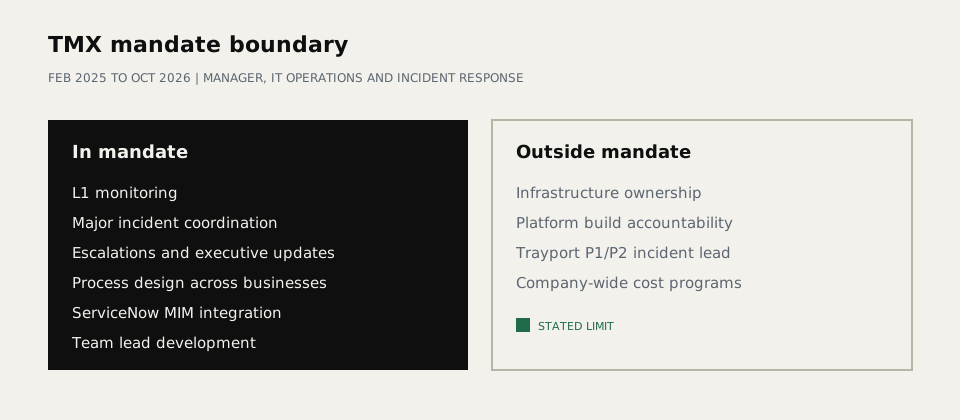
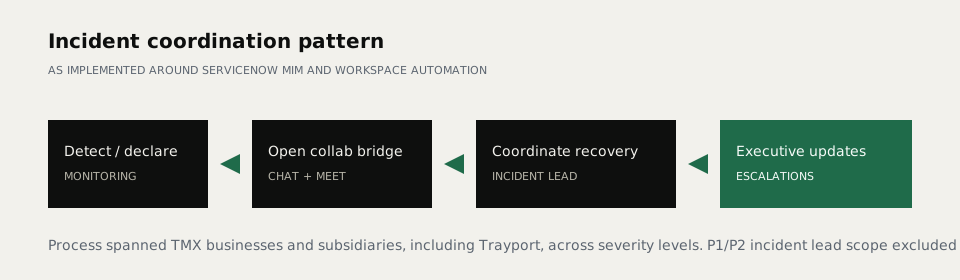
TMX: a unified L1 monitoring and major incident team through three team leads, with ServiceNow MIM bridges.
Technology operations and service delivery leader. Monitoring, major incidents, vendors and operating budgets at TMX Group, BMO and BlackBerry. Based in the Toronto area, seeking a senior leadership role in Canada.

Incident leadership
P1/P2 Incident Lead
TMX: a unified L1 monitoring and major incident team through three team leads, with ServiceNow MIM bridges.
People and vendors
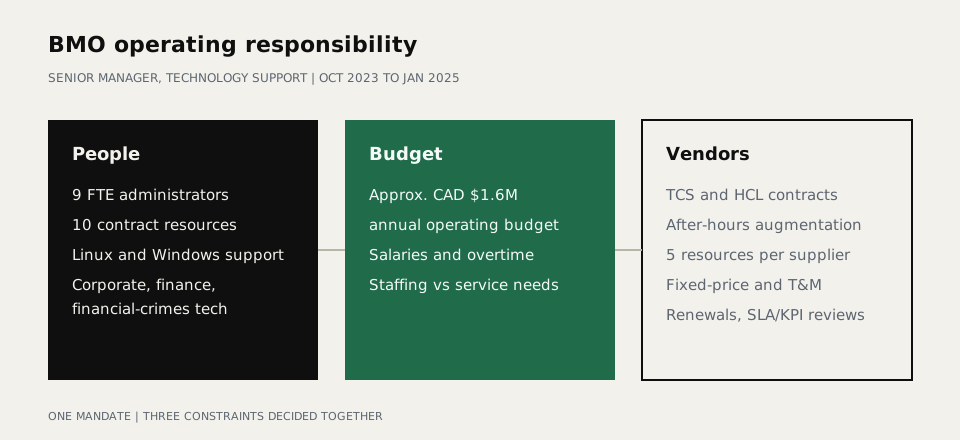
9 FTE and 10 contract
BMO: Linux and Windows administrators plus TCS and HCL staff augmentation, in cloud and on-premises environments.
Operating budget
CAD ~$1.6M
BMO annual budget: overtime against service needs, vendor renewals, SLA reviews and performance escalations.
Service ownership
99.999% SLA target
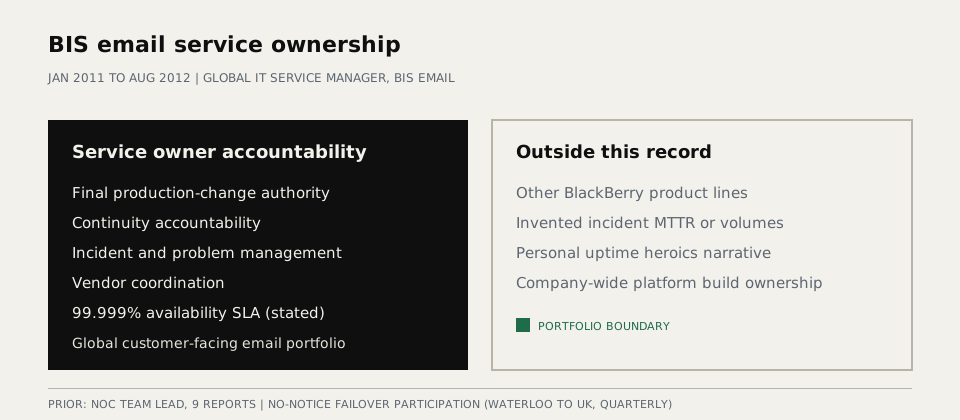
BlackBerry BIS email owner with final production-change authority. The role’s stated service target.
Operating change
17 → 14 people
TMX: CDS Post Trade Modernization merged two support groups into one monitoring and major incident model.
NOC leadership
9 direct reports
Earlier BlackBerry NOC team lead; joined no-notice failovers of live traffic from Waterloo to the UK, at least quarterly.
I look for senior mandates where ownership is clear, authority matches accountability, and the scope is sustainable.
TMX monitoring and major-incident leadership through team leads; BMO leadership of 9 FTE and 10 contract resources; BlackBerry NOC team of 9.
Cross-business TMX incident process; BMO production change authority within scope; BlackBerry portfolio change authority for BIS email.
TMX P1/P2 Incident Lead (excluding Trayport); ServiceNow MIM integration; earlier major-incident facilitation at BMO.
BMO CAD $1.6M operating budget with TCS and HCL contract management; BlackBerry vendor coordination for global email.
BMO Ansible Automation Platform adoption for online banking; independent Nexus Code, Homelab AI, Citable, and Nebula Components.
One of the qualities that truly sets Mike apart is his ability to remain calm and composed, even in the face of challenges or tight deadlines.
…he demonstrated strong collaboration and coordination skills with clear understanding of roles and responsibilities of multiple functional groups across the organization.
Mike is an extremely capable individual and possesses the excellent ability to focus in on the technical and business goals, while keeping the big picture in mind.
Led a unified L1 Monitoring and Major Incident Management team through three team leads. Accountable for escalations, executive communications, and developing team leads. Scope was monitoring and major incident operations, not infrastructure ownership.
As Senior Manager, led 9 FTE systems administrators and 10 contract resources supporting corporate, finance, and financial-crimes technology across cloud and on-premises environments. Managed an approximately CAD 6 million annual operating budget.
Service owner for a global email service with a 999% availability SLA. Accountable for continuity, incident and problem management, vendor coordination, and production change governance within that portfolio. Earlier, led a NOC team of 9 direct reports.
 Escalation
Major incident leadership with executive communications and a documented severity process, at TMX and earlier at BMO.
 Change
 governance and control attestations in assigned scope, with production change authority for a named service portfolio.
 Vendors
Renewals, SLA and KPI reviews and performance escalations inside operating budgets, for TCS and HCL at BMO.
 Recovery
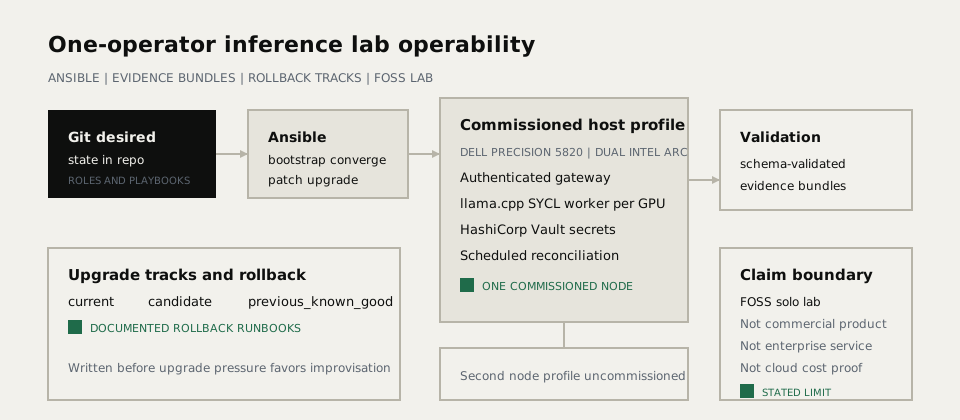
Stated availability ownership for BIS email, no-notice failovers in the BlackBerry NOC, and desired-state, validation and rollback paths in Homelab AI.
 Hygiene
Vulnerability and patch automation for Internal Audit at BMO, and approval controls in Nexus Code. This is operational hygiene; CISO, penetration testing and certification work sit outside it.
Where AI fits
AI is an operational capability: useful use cases, workflows that can be operated, and governance held to the standard of monitoring and change. Homelab AI, Nexus Code, Citable and Nebula Components show recovery discipline in public.
Employer roles were technology operations mandates. The AI work shown here is personal project work, kept separate from enterprise client outcomes.
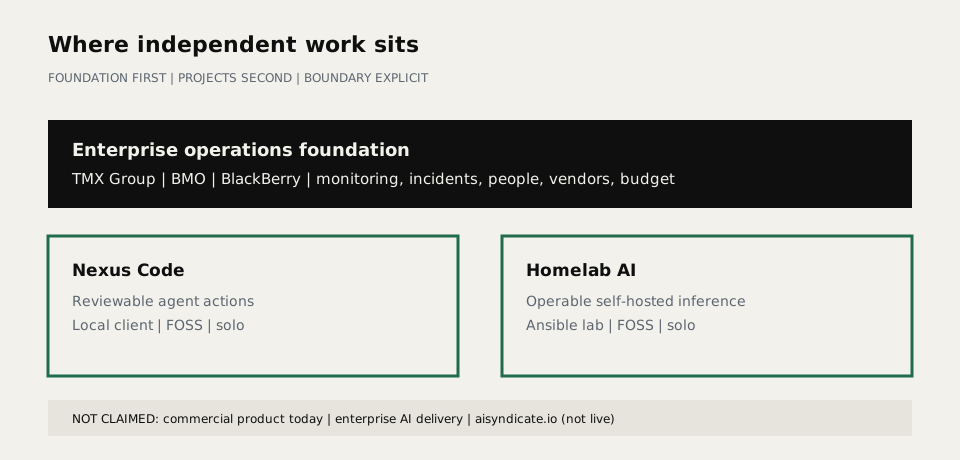
Operational question: how can an agentic coding tool make its actions reviewable instead of hiding them behind a single permission switch?
Operational question: how do you treat self-hosted inference like an operable system (desired state, validation evidence, and rollback) when you are the only operator?
Operational question: how do you diagnose observable landing-page conversion friction with evidence-backed findings, without promising lift?
Operational question: how do you make SEO, AEO, and GEO audit findings defensible by binding them to evidence, change control, and explicit unknowns?